- Other Worlds
- Posts
- The Hidden Geometry: Why Nature Keeps Drawing the Same Shapes
The Hidden Geometry: Why Nature Keeps Drawing the Same Shapes
From the spiral of a nautilus shell to the hexagons of a honeycomb, the same patterns appear again and again across the living world. Are they a cosmic signature, or simply the mathematics of efficiency?
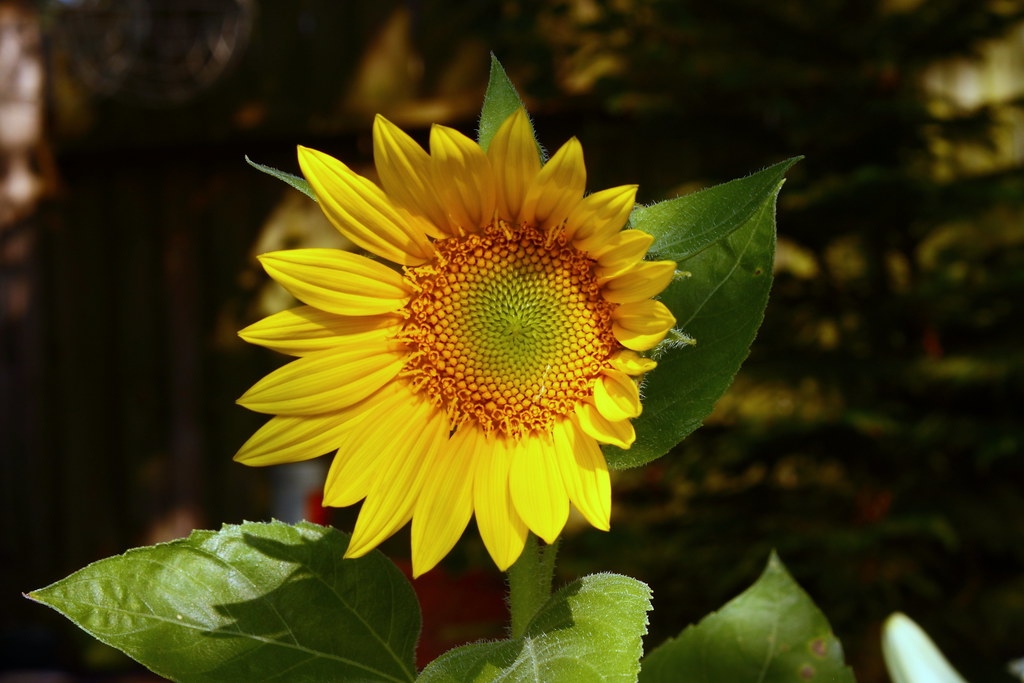
Image: "Morning Jun 3 2011" by ArturoYee (CC BY 2.0) via Openverse
Split open a sunflower head and look closely at the crowded center. The seeds are not scattered at random. They spiral outward in two interlocking sets of curves — one winding clockwise, the other counterclockwise — and if you have the patience to count them, you will almost always find numbers like 34 and 55, or 55 and 89. These are not arbitrary figures. They belong to a sequence that mathematicians have studied for eight centuries, and that mystics have contemplated for far longer.
The sunflower does not know arithmetic. Yet it builds itself according to a rule so precise that it has convinced generations of thinkers that the universe is written in a mathematical language — and that certain shapes are, in some sense, sacred. This is the terrain of "sacred geometry": the idea that specific proportions and forms recur throughout nature because they carry meaning, order, and perhaps even design. It is a claim that sits at the crossroads of hard mathematics and ancient philosophy, and untangling the two is one of the more rewarding puzzles in the study of pattern.
What Sacred Geometry Actually Claims
Sacred geometry is not a single doctrine but a family of related beliefs. At its heart is the conviction that geometric proportions found in nature — the golden ratio, the spiral, the hexagon, the branching fractal — are not accidents but expressions of a deeper cosmic order. Adherents point to the same forms appearing in seashells, galaxies, flowers, and the human body, and conclude that a unifying blueprint underlies creation.
The tradition is ancient and well documented. Plato, in the Timaeus (circa 360 BC), argued that the cosmos was constructed from five regular solids — the tetrahedron, cube, octahedron, dodecahedron, and icosahedron — each associated with an element. These "Platonic solids" became foundational to Western geometric mysticism. Centuries later, the astronomer Johannes Kepler was so enchanted by them that in his 1596 work Mysterium Cosmographicum he tried to model the orbits of the planets by nesting the five solids inside one another. He was wrong about the planets, but his instinct — that mathematics and cosmos are intimately joined — helped launch modern astronomy.
What is documented, then, is that humans have long perceived and revered geometric order in nature. What remains disputed is whether that order carries intrinsic meaning, or whether we are simply very good at finding patterns and assigning significance to them. To weigh the question honestly, it helps to look at the shapes themselves.
The Golden Ratio and the Fibonacci Spiral
The most famous figure in sacred geometry is the golden ratio, usually written with the Greek letter phi (φ) and equal to roughly 1.618. It is defined simply: divide a line so that the ratio of the whole to the larger part equals the ratio of the larger part to the smaller, and you arrive at phi. The number has genuinely remarkable mathematical properties, and it is closely tied to the Fibonacci sequence — 1, 1, 2, 3, 5, 8, 13, 21, 34, 55, 89 — in which each term is the sum of the two before it. As the sequence grows, the ratio between consecutive numbers converges on phi.
Here the mathematics is not in doubt. Leonardo of Pisa, known as Fibonacci, introduced the sequence to Europe in his 1202 book Liber Abaci, using it to model the idealized growth of a rabbit population. And the sequence does appear in nature with startling regularity:
- The spiral arrangement of seeds in a sunflower head follows Fibonacci counts.
- Pinecones and pineapples show Fibonacci numbers in their overlapping scales.
- Many flowers — lilies, buttercups, daisies — bear petals in Fibonacci quantities: 3, 5, 8, 13, 21.
- The branching of trees and the arrangement of leaves along a stem often follow the same numbers.
This last phenomenon, the arrangement of leaves, is called phyllotaxis, and it is where the mystery becomes tractable. Botanists have shown that when a plant places each new leaf or seed at an angle of roughly 137.5 degrees from the previous one — the so-called "golden angle," derived directly from phi — it achieves the most efficient possible packing. No two leaves shadow each other completely; no two seeds waste space. The plant that grows this way captures more sunlight and fits more seeds into the same disk than one growing by any other angle.
In other words, there is a documented physical reason the Fibonacci pattern recurs: it is the solution to an optimization problem that natural selection stumbles upon repeatedly. The spiral is not imposed from above. It emerges from below, from the simple mechanics of cells budding one after another at a consistent angle.
Hexagons, Spirals, and the Economy of Form
The honeybee's comb offers another case. Its cells are near-perfect hexagons, and for centuries this was cited as evidence of some innate geometric wisdom. The truth, confirmed by both mathematics and physics, is more elegant. In 1999, mathematician Thomas Hales proved the "honeycomb conjecture": that a hexagonal grid is the most efficient way to divide a surface into regions of equal area with the least total perimeter. Bees building with wax — a costly material — are effectively minimizing effort. Experiments suggest that bees actually build circular cells first, and the soft wax, warmed by the colony, flows into hexagons through simple surface tension, the way soap bubbles pack together. Physics finishes what biology begins.
Spirals tell a similar story. The chambered nautilus is endlessly invoked as an example of the golden spiral. In reality, the nautilus grows in a logarithmic spiral, but careful measurement shows its expansion rate is closer to 1.3 than to phi — a beautiful spiral, but not the golden one of legend. This distinction matters. Logarithmic spirals appear everywhere in nature — in hurricanes, in ram's horns, in the arms of galaxies — because they are the natural shape of anything that grows by adding material at a constant proportional rate while keeping its form. The spiral is a signature of growth itself, not of any single sacred number.
The pattern is consistent: where sacred geometry sees a cosmic design, mathematics and physics usually find an efficiency, and biology finds a survival advantage. This does not diminish the beauty. If anything, it deepens it, because it means the same handful of rules generate the diversity of the living world.
Where Evidence Ends and Speculation Begins
It is worth being clear about where the documented science stops. The claim that phi appears in the proportions of the human body — the navel dividing the height at the golden ratio, the joints of the fingers, the spirals of the ear — is far weaker than commonly presented. Human proportions vary enormously, and studies attempting to confirm a universal golden ratio in anatomy have produced mixed and often unpersuasive results. The famous assertion that the Parthenon or the Great Pyramid were deliberately built to golden proportions is also disputed; the numbers can be made to fit, but there is little evidence the builders intended them, and much depends on which edges and measurements one chooses.
This is the crucial caution. The golden ratio is close to many simple fractions — 3/2, 5/3, 8/5 — so a measurement that lands near 1.6 can be "found" almost anywhere if one goes looking. Human beings are pattern-seeking creatures; the tendency to perceive meaningful structure in random data even has a name, apophenia. Much of what circulates as proof of sacred geometry is the product of this instinct, applied selectively and after the fact.
And yet dismissing the whole tradition would be a mistake. The genuine, verifiable recurrence of Fibonacci numbers in phyllotaxis, of hexagons in packed structures, of logarithmic spirals in growth, of fractal branching in trees, blood vessels, and river deltas — these are real. Nature does return, again and again, to a limited vocabulary of forms. The mystics who sensed this were not hallucinating; they were reading a real signal, even if their interpretation of its source went beyond what could be shown.
The Symbol and the Substance
Perhaps the most honest way to hold sacred geometry is to separate the description from the explanation. As a description, it captures something true: the universe is astonishingly economical, reusing the same efficient shapes across scales that span from the molecular to the galactic. The Flower of Life, the Platonic solids, the golden spiral — these have served for millennia as maps of that intuition, tools for meditation on order and interconnection. Their cultural power, like that of the Tree of Life, lies precisely in their universality.
As an explanation — a claim that these forms were placed in nature by design, or that specific numbers carry mystical energy — sacred geometry ventures past the edge of evidence into faith and philosophy. That is not a criticism, only a boundary. Some questions about why the universe should be so mathematically ordered in the first place remain genuinely open, and physicists no less than mystics have marveled at them. The physicist Eugene Wigner famously wrote in 1960 of "the unreasonable effectiveness of mathematics in the natural sciences," a phrase that captures the wonder without resolving it.
So the next time you hold a pinecone or trace the spiral of a shell, consider both truths at once. The pattern in your hand is the output of a simple rule, refined over hundreds of millions of years because it works. And it is also a small window onto a stranger fact — that the cosmos should be the kind of place where such rules exist at all, where beauty and efficiency so often turn out to be the same thing. Whether that convergence is a message or merely a marvel may be the oldest question we have. Nature, for its part, simply keeps drawing the same shapes, and leaves the meaning to us.