- Other Worlds
- Posts
- How Sirius Shaped Ancient Egyptian Civilization
How Sirius Shaped Ancient Egyptian Civilization
From the dawn of civilization, humanity has looked to the heavens for guidance, inspiration, and meaning. Among the countless stars adorning the night sky, one shinesbrighter than all others—Sirius, often called the "Dog Star." For the ancient Egyptians, Sirius wasn’t just a celestial body; it was a cosmic key tied to timekeeping, mythology, agriculture, and spirituality. This article explores the Sirius connection to Egypt, uncovering how one star shaped an entire civilization’s worldview.

Jerry Brooks
February 22, 2026
Introduction:
The Star Sirius and Its Timeless Allure
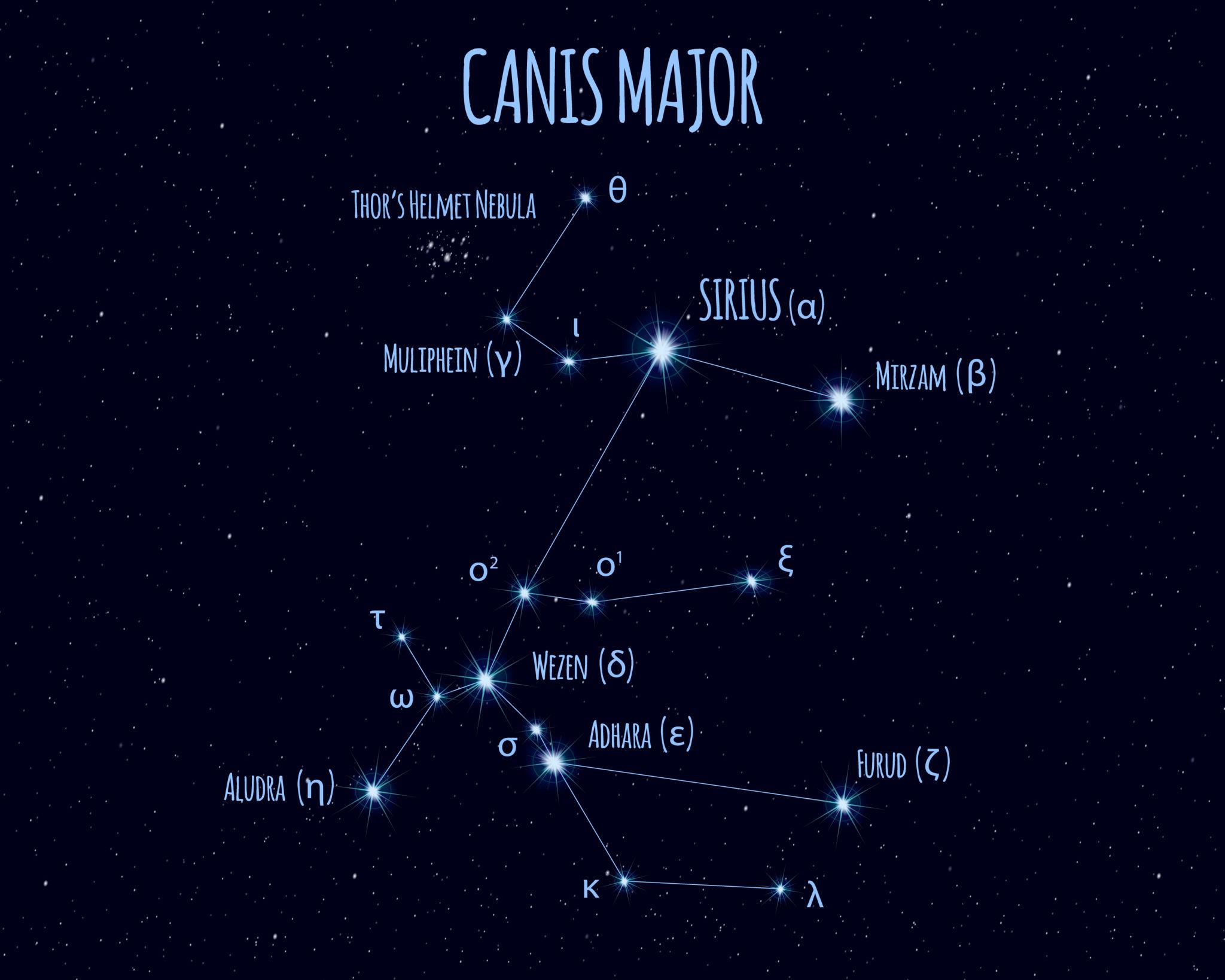
Sirius has fascinated cultures across the globe, from Mesopotamia and Greece to the Dogon
tribe of Mali. Yet, nowhere did this star hold as much importance as in ancient Egypt. The
Egyptians wove Sirius into their religion, mythology, and even the foundation of their
calendar [1]. For them, Sirius wasn’t simply a distant star. It was Isis in the sky, a beacon of
renewal and abundance that heralded the life-giving floods of the Nile [1].

Understanding Sirius: The Brightest Star in the Sky Astronomical Features of Sirius It is actually a binary star system, consisting of Sirius A, a bright main-sequence star, and Sirius B, a faint To the naked eye, it appears as the brightest star in the night sky, outshining all others except the Sun, Moon, and some planets [1]. Mythological Significance Across Cultures
In Polynesian navigation, Sirius guided sailors across vast oceans. In Egyptian belief, however, Sirius transcended navigation or heat—it became a →How did Sirius influence ancient Egyptian civilization? | 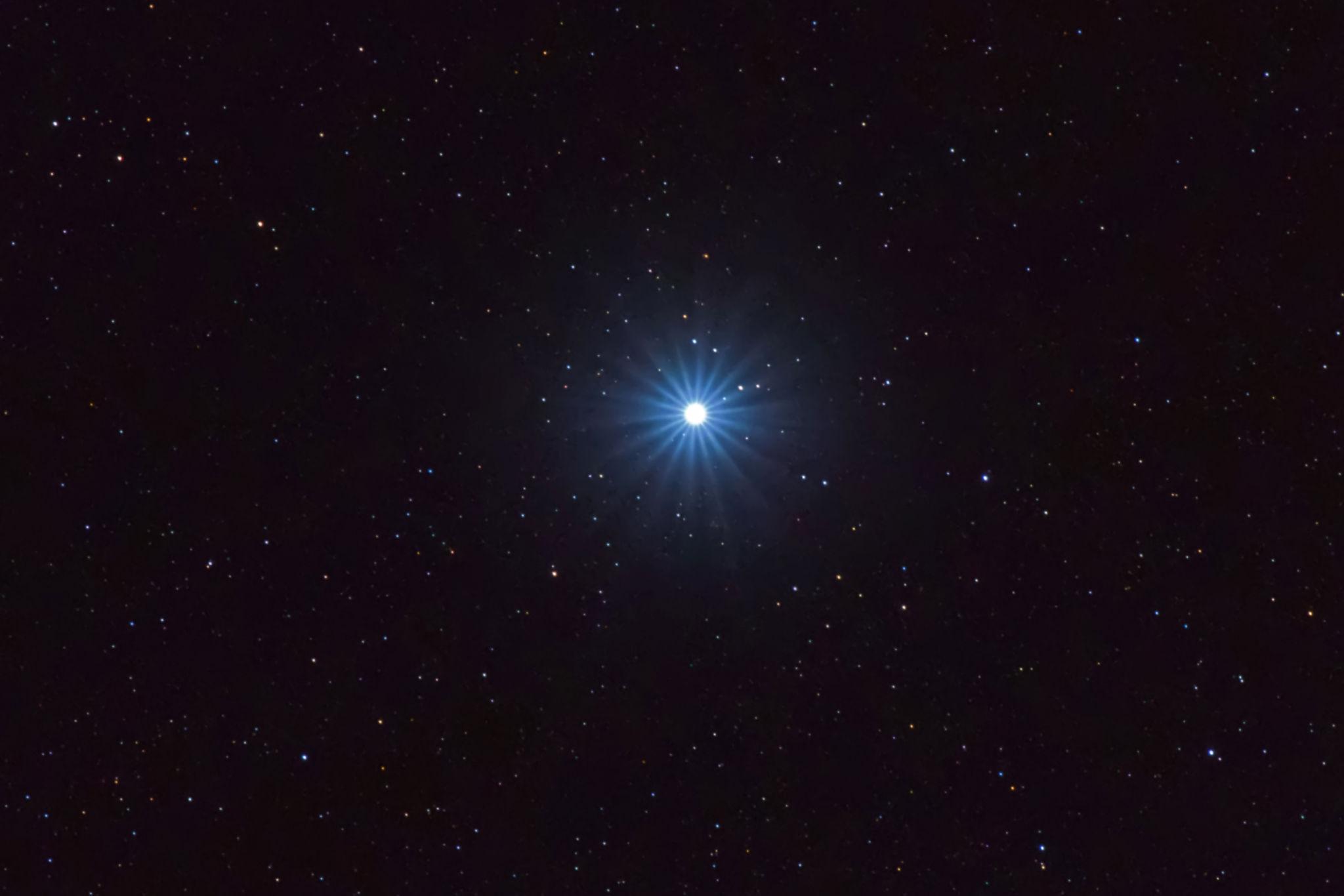 |
The Role of Sirius in Egyptian Astronomy
Sirius and the Egyptian Calendar System
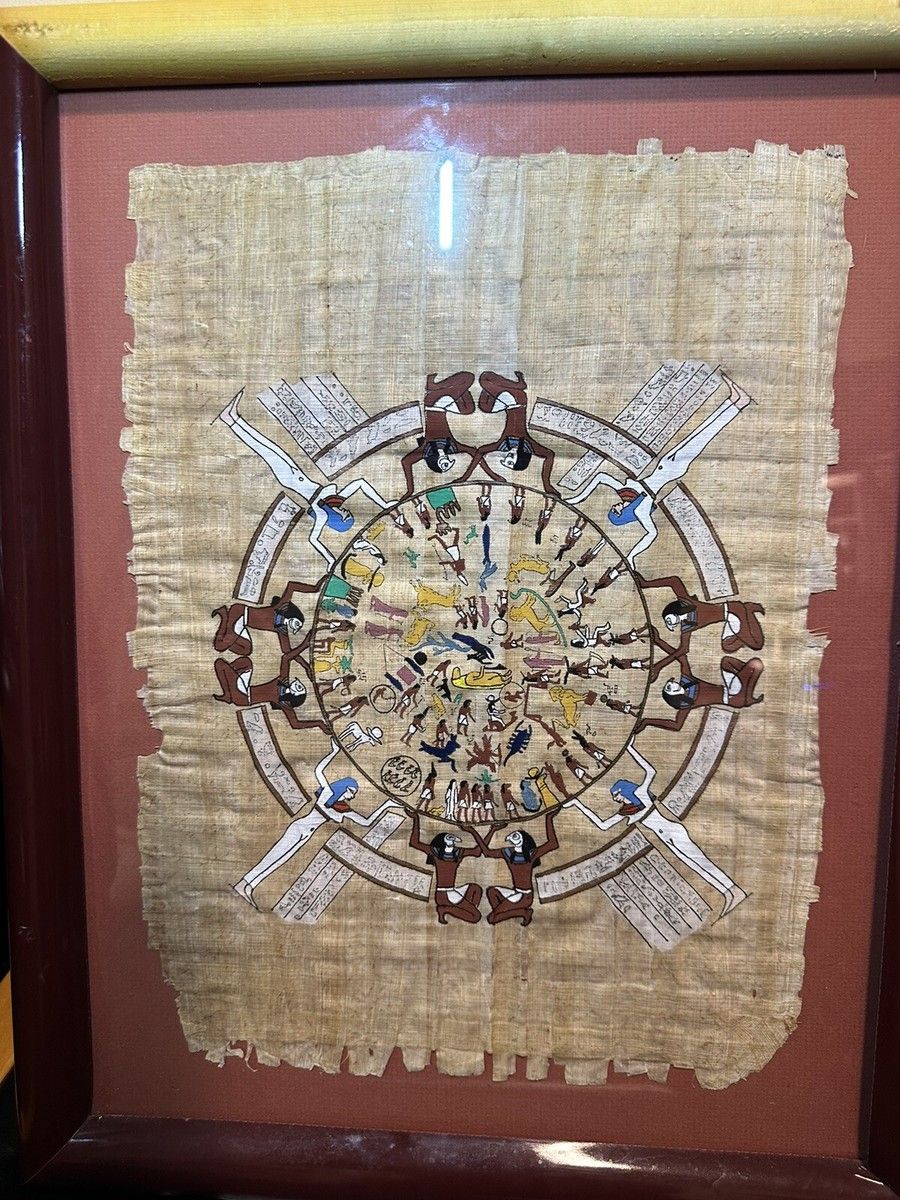
The ancient Egyptian civil calendar, a 365-day system, was meticulously developed, yet the
true agricultural year and the rhythm of Egyptian life were inextricably linked to the heliacal
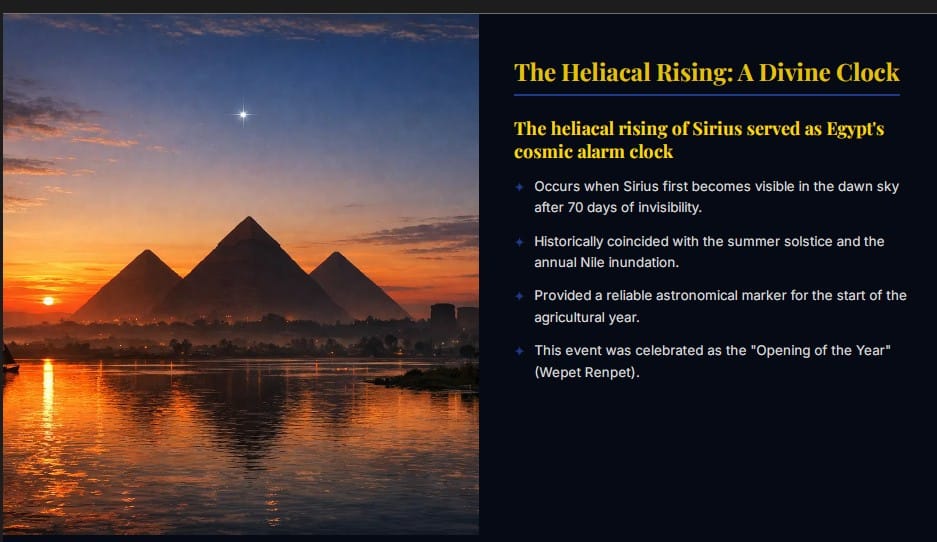
rising of Sirius [1]. This celestial event, marking the star's first visible appearance in the
dawn sky after approximately 70 days of invisibility, occurred annually around mid-July in
the Julian calendar [1]. This precise timing was a cosmic signal, heralding the annual
inundation of the Nile River, crucial for their civilization. The Egyptians observed their 365-
day calendar gradually drifting out of sync with the solar year and Sirius's heliacal rising.
This led to the Sothic cycle, a grand celestial period of 1,461 Egyptian civil years (365 days
each) or 1,460 Julian years (averaging 365.25 days). This cycle describes the duration it took
for the 365-day civil calendar to realign with Sirius's heliacal rising, a testament to their
advanced astronomical observations and deep understanding of celestial mechanics [2].
The Sothic cycle was a fundamental pillar of their chronology and religious practices,
ensuring festivals and agricultural activities were synchronized with the divine order of the
cosmos.
The Heliacal Rising of Sirius and the Nile Floods
Crucially, the heliacal rising of Sirius coincided with the inundation of the Nile River, a
phenomenon vital to Egyptian agriculture. This synchronicity made Sirius the ultimate
herald of fertility and abundance. To the Egyptians, it wasn’t a coincidence—it was divine
order [1].
Sirius and the Goddess Isis
The Myth of Isis and Osiris Linked to Sirius
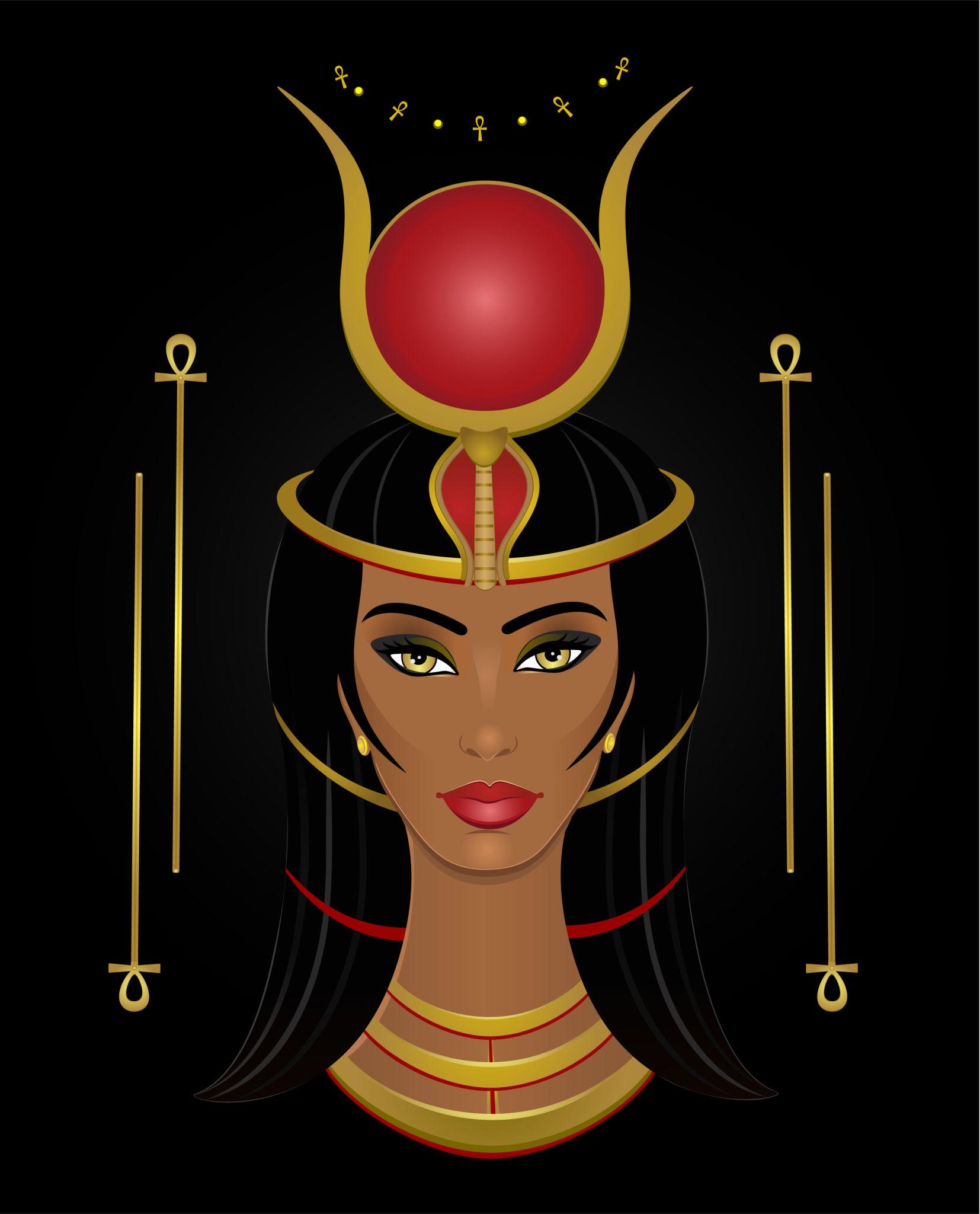
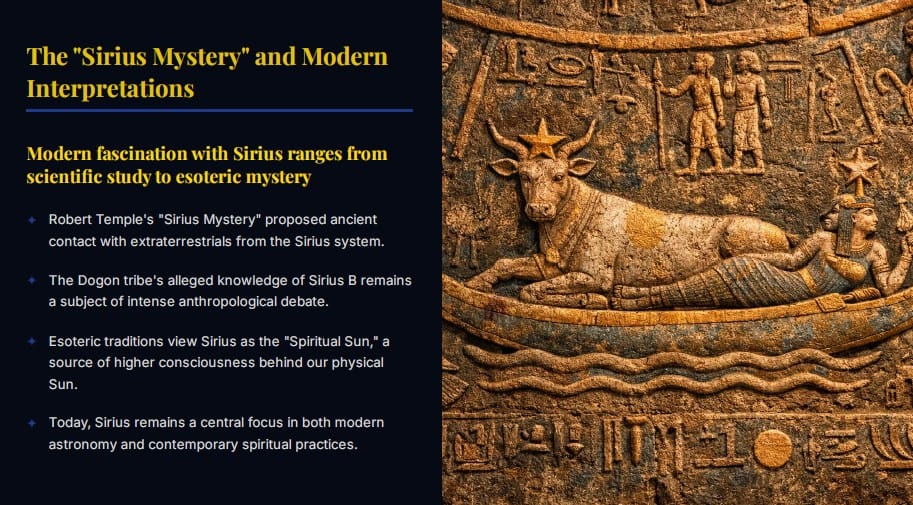
In Egyptian mythology, Isis, the revered great mother goddess, was inextricably identified
with Sirius, embodying magic, motherhood, and fertility. Her husband, Osiris, god of the
underworld and rebirth, was associated with Orion. Together, Isis (Sirius) and Osiris (Orion)
formed a powerful cosmic pair, their celestial dance reflecting earthly and spiritual cycles.
The myth of Isis searching for Osiris's body, leading to his resurrection and the conception
of Horus, paralleled the star's cyclical disappearance and dramatic return [1]. This cosmic
narrative reinforced the belief in cyclical death and rebirth, a central theme in Egyptian
religious thought
Sirius as a Symbol of Rebirth and Fertility
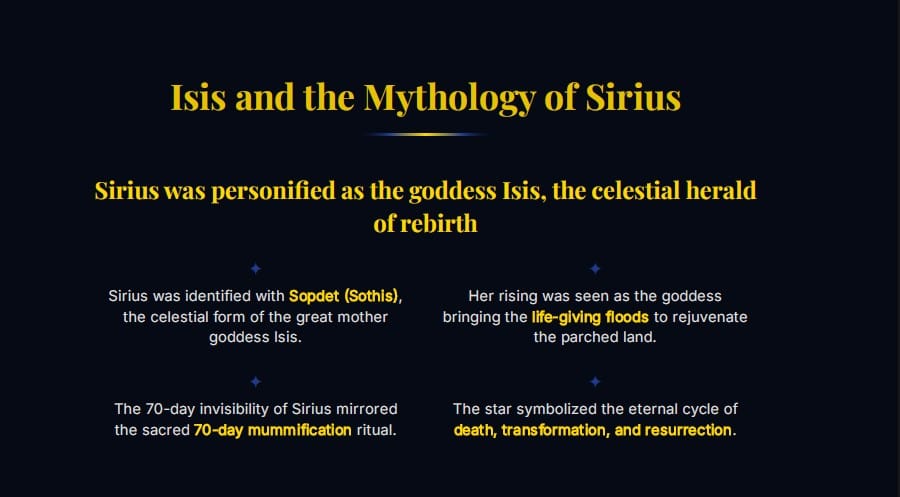
For ancient Egyptians, Sirius embodied rebirth, motherhood, and resurrection. Its annual
heliacal rising, coinciding with the Nile's life-giving inundation, was seen as a direct
manifestation of Isis's power to bring fertility and abundance, just as she revived Osiris [1].
This mythological connection made Sirius central to both practical survival and religious
devotion. The approximately 70-day period of Sirius's invisibility also mirrored the 70-day
mummification process, cementing its association with death, transformation, and rebirth,
linking the celestial cycle directly to the human journey [3].
Architectural Alignments with Sirius
The Great Pyramids and Stellar Alignments
The Great Pyramids of Giza stand as enduring testaments to ancient Egypt's profound
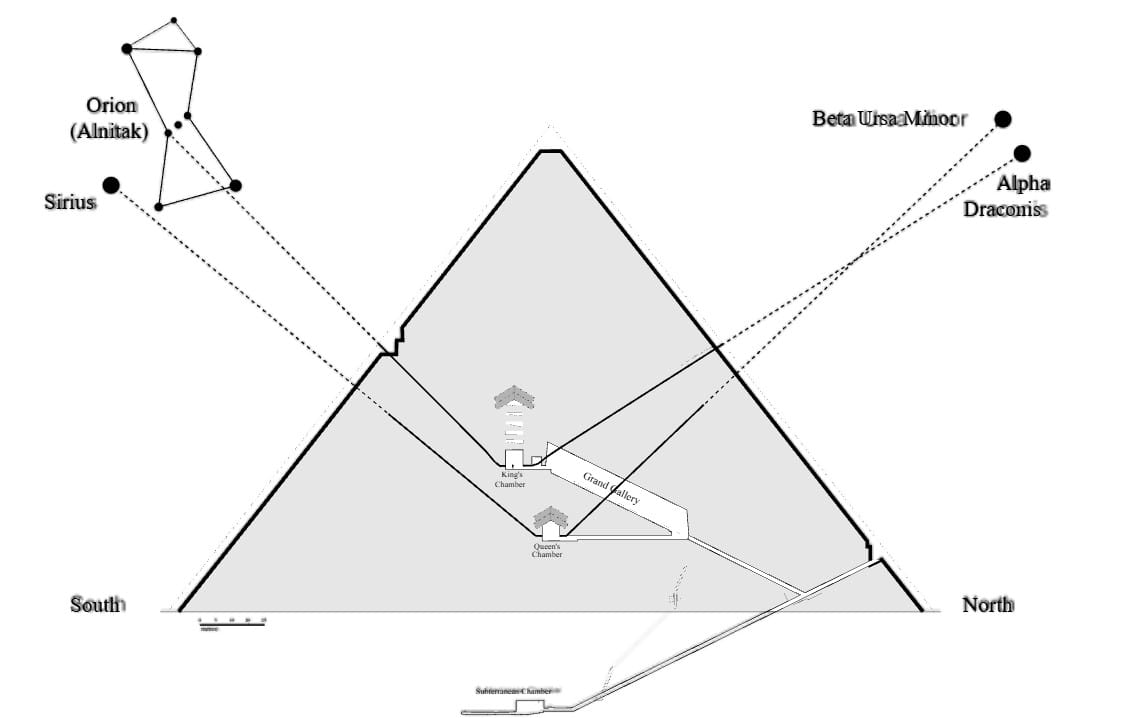
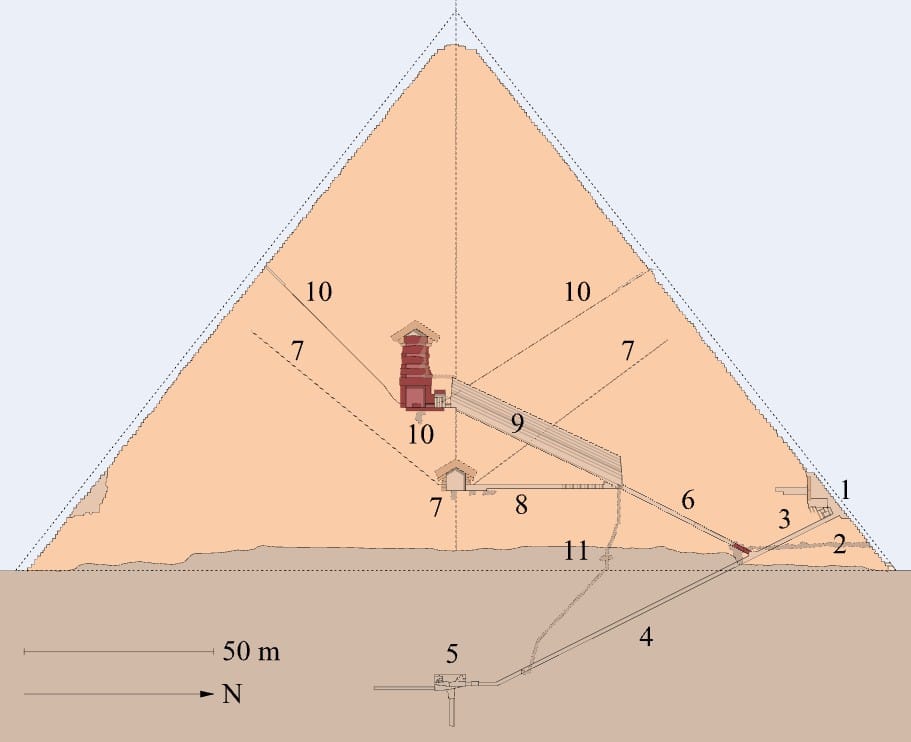
astronomical knowledge and spiritual beliefs. Many scholars contend these monumental structures were meticulously aligned not only with Orion’s Belt but also with crucial stellar points associated with Sirius [1]. These precise alignments were deeply symbolic, reinforcing the Egyptians’ belief that their kings’ souls would ascend to the stars after death.
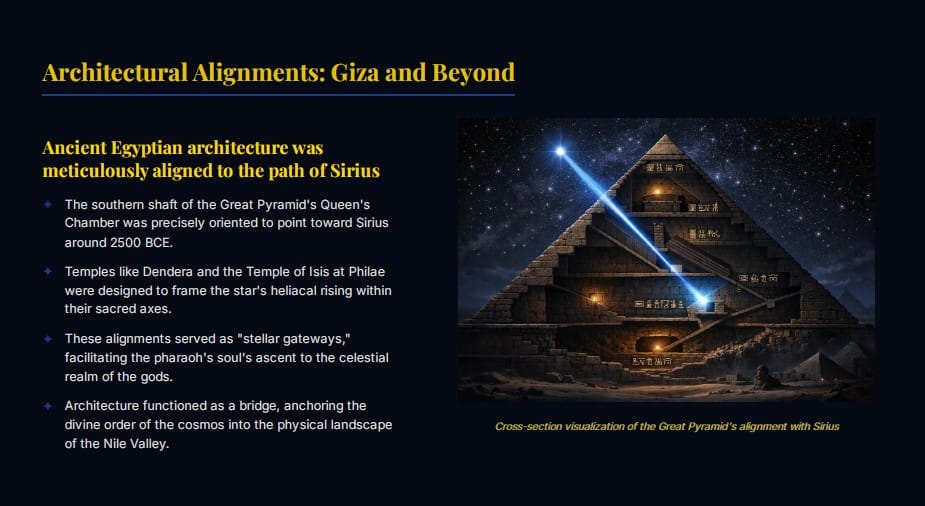
For instance, the southern shaft of the Queen's Chamber in the Great Pyramid is
theorized by researchers like Robert Bauval to have pointed directly towards Sirius around 2500 BCE, connecting the pharaoh's eternal resting place with the star of Isis and rebirth [3]. Such alignments underscore the Egyptians' conviction that the cosmos was an integral part of their spiritual landscape, guiding their architectural endeavors and shaping their understanding of the afterlife.
The Temple of Dendera and Astronomical Symbolism
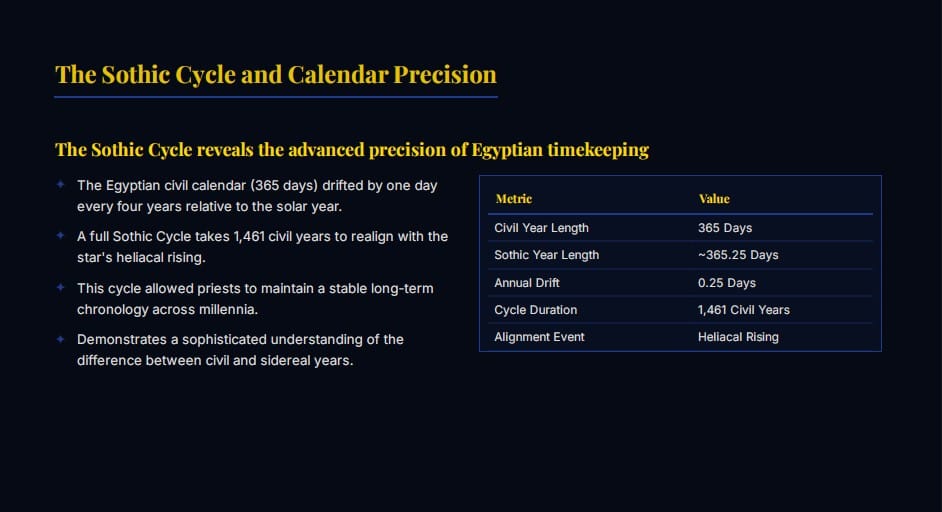
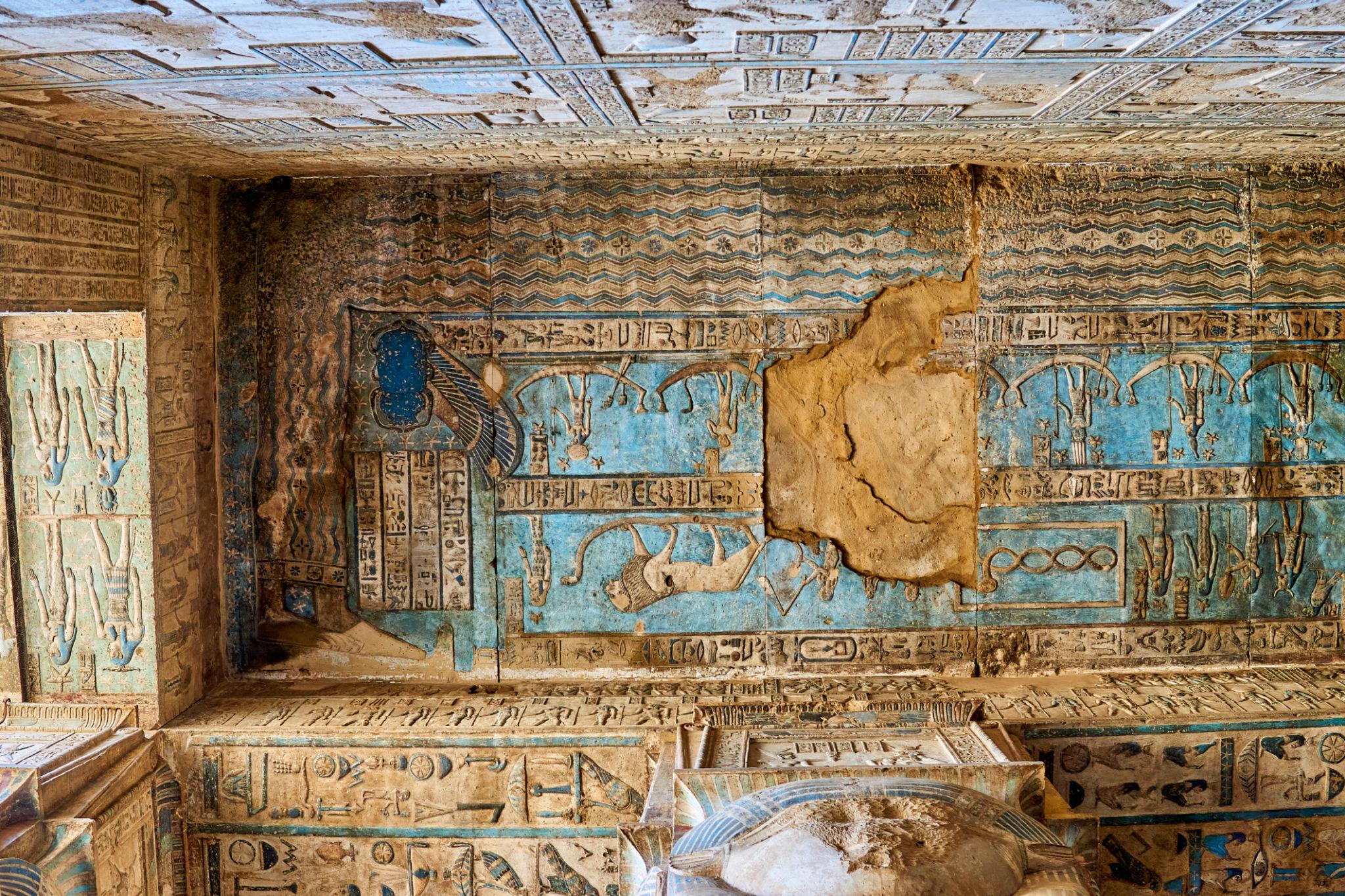
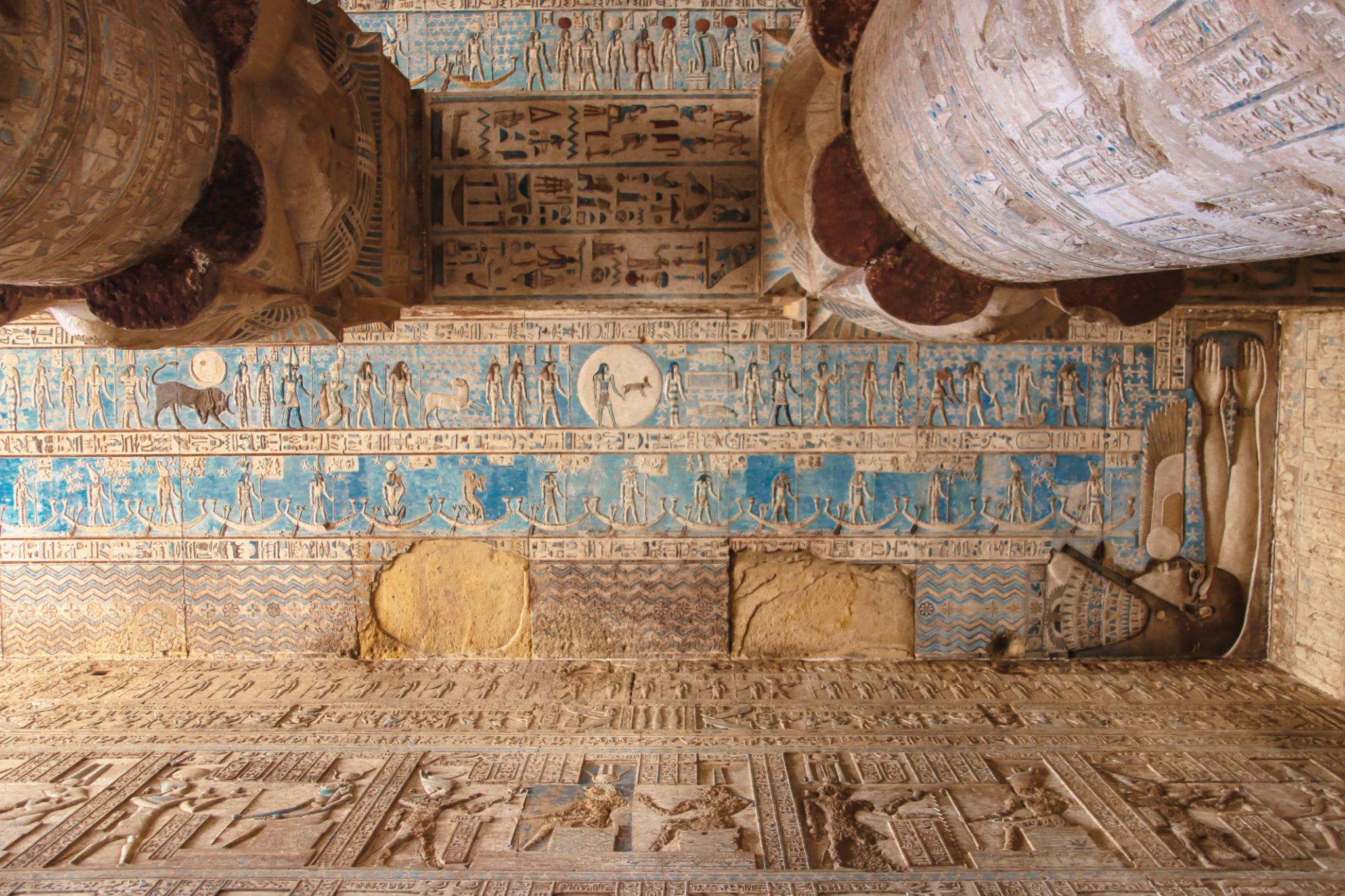
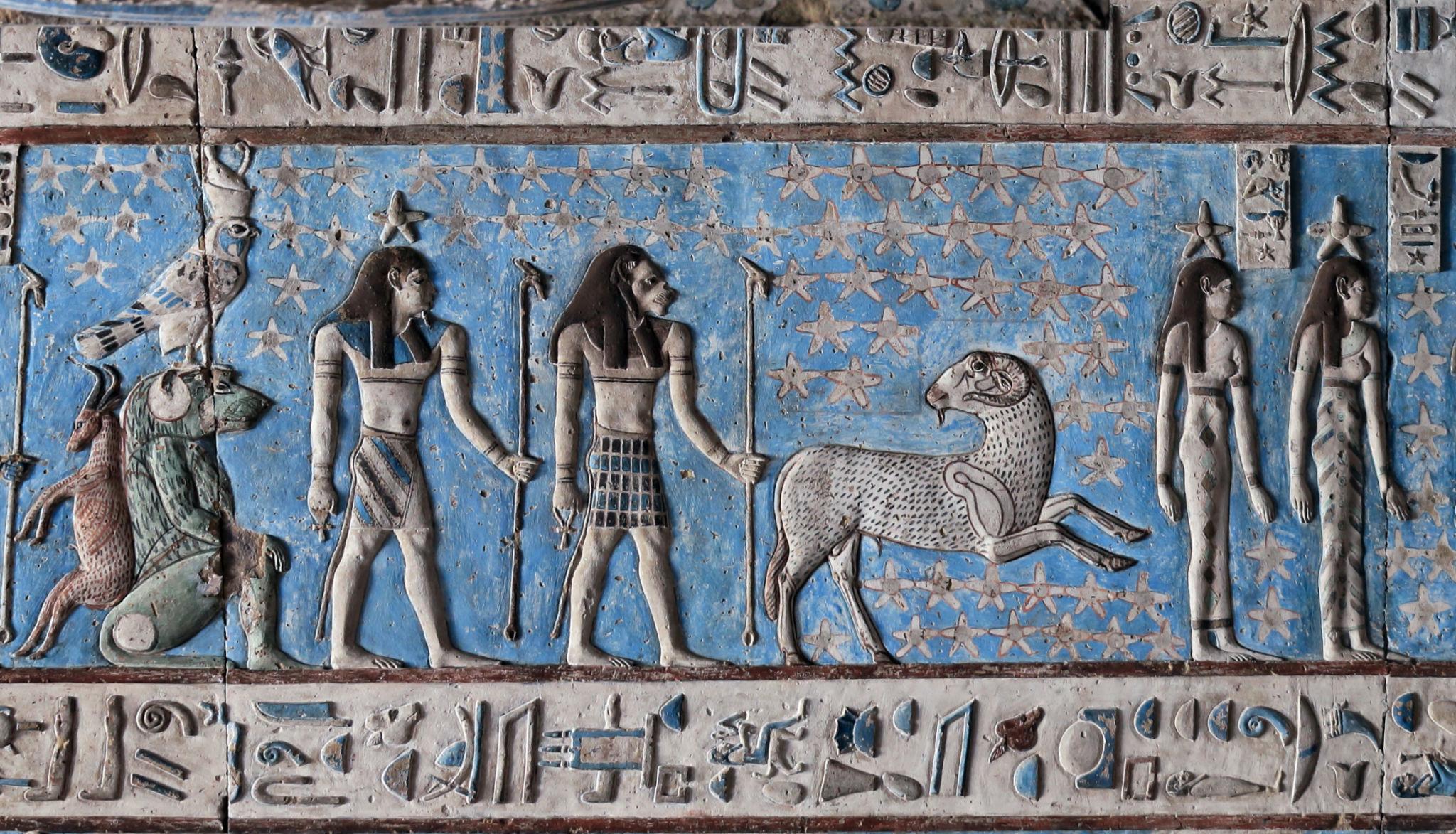
The Temple of Hathor at Dendera features intricate astronomical ceilings vividly depicting
Sirius (as Sopdet) alongside other celestial bodies. These carvings suggest sophisticated
ritual practices connected to star observation and celestial movements [1]. The renowned
"Zodiac of Dendera," a circular bas-relief, stands as a monumental testament to Sirius's
importance (Sopdet) within their cosmic understanding, integrating it into a complex
astrological and astronomical framework [3]. This temple, dedicated to the goddess of
fertility, motherhood, and cosmic love, further solidified the link between Sirius and the
divine feminine principles embodied by Hathor and Isis.
Other Temples Aligned with Sirius
Beyond Giza and Dendera, numerous other temples across Egypt, including Abydos and Edfu, exhibit deliberate architectural alignments meticulously designed to frame Sirius during its heliacal rising [1]. These precise orientations were the culmination of centuries of astronomical observation and sophisticated engineering. Such architectural feats unequivocally reveal the ancient Egyptians’ profound and advanced astronomical knowledge, demonstrating their ability to integrate celestial phenomena into the very fabric of their sacred spaces. More importantly, these alignments underscore their unwavering devotion to Sirius, recognizing it as a divine entity that governed the rhythms of their world and held the key to cosmic understanding.
Conclusion:
Sirius, Egypt, and the Eternal Cosmic Bond
The Sirius connection to Egypt reveals how deeply the ancients intertwined the cosmos with their daily lives. For them, Sirius wasn’t just a star—it was a goddess, a clock, a beacon of renewal, and a spiritual teacher [1]. Whether seen through the lens of astronomy, mythology, or spirituality, Sirius continues to inspire wonder. It reminds us that humanity has always looked upward, seeking meaning among the stars.
References and Further Reading
[1]: https://www.example.com/sirius-egypt-blog)
(Placeholderforthecurrentblogpost,asitcontainstheinitialoutlineandkeypoints "The Sirius
Connection to Egypt: Unveiling Ancient Cosmic Mysteries"
[2]: https://en.wikipedia.org/wiki/Sothic_cycle "Sothic cycle - Wikipedia"
[3]: https://storytellersnightsky.com/sirius-and-the-flooding-of-the-nile "Sirius and the
Flooding of the Nile - The Storyteller's Night Sky"
[4]: https://www.csicop.org/si/show/sirius_mystery_revisited "Debunking the Sirius-Dogon
Connection"
[5]: https://www.gaia.com/article/sirius-star-spiritual-meaning)
(PlaceholderforageneralarticleonspiritualinterpretationsofSirius "Sirius as the “Spiritual
Sun” and its Influence"
A Final Note
As I conclude this exploration of the Sirius–Egypt connection, I want to leave you with something personal.
Standing inside the chambers of the Great Pyramid of Giza is not like viewing it in a documentary or reading about it in a textbook. When you move through the ascending passages and stand within the King’s Chamber, you feel the precision — the intentionality. The angles, the shafts, the geometry. Looking upward and later studying the sky above the Giza Plateau, the alignment between architecture and the stars no longer feels abstract. It feels deliberate.
Many researchers agree that the builders of the pyramids possessed sophisticated astronomical knowledge. Some scholars argue that the structures were constructed during Egypt’s Old Kingdom under the Fourth Dynasty. Others explore alternative hypotheses suggesting earlier phases of development or inherited architectural knowledge. While mainstream Egyptology attributes the pyramids to ancient Egyptian civilization, debates about phases of occupation, adaptation, and reinterpretation continue to inspire inquiry.
What is clear is this: the monuments at the Pyramids of Giza are not random stone structures. They encode cosmology, mathematics, and celestial symbolism. The alignment theories — whether toward Orion, Sirius, or cardinal directions — point to a civilization deeply attuned to the sky.
And then there are the ongoing discoveries. Subterranean chambers, voids detected through muon scanning, and structural anomalies beneath the pyramid complex continue to raise new questions. What remains undiscovered below the surface? What knowledge may still be sealed within the bedrock?
Cultures searching for meaning is only the beginning. The deeper question is whether these structures were designed as symbolic bridges — linking earth and sky, mortality and eternity, human and cosmic order.
So I leave you with the same questions this blog has explored:
How did Sirius influence ancient Egyptian civilization?
Why was Sirius considered sacred?
Were the pyramids intentionally aligned to specific stars?
Did the builders possess astronomical knowledge beyond what we currently credit them for?
And what might still lie beneath the surface of the Giza Plateau?
If this article has sparked your curiosity, I invite you to revisit my previous piece on the pyramids, where I explore their engineering, geometry, and the mysteries surrounding their construction in greater depth.
Because the story of Sirius and Egypt is not simply about one star — it is about humanity’s enduring quest to understand its place in the cosmos.
“The only true wisdom is in knowing you know nothing.”
-Socrates
“You have power over your mind — not outside events. Realize this, and you will find strength.” - Marcus Aurelius
Until next time,
«€eez∆eR»
